Estimate Kakobuy Climbing Shoe Shipping
Estimate Kakobuy Climbing Shoe Shipping
International shipping costs for climbing shoes cannot be determined by the shoe weight alone. The full shoe box, outer carton, and protective padding increase both the actual weight and the volumetric weight; even if removing the shoe box only reduces a few hundred grams, it may push the package across a shipping line's billing tier.
This article helps you organize weighing and dimension data before submitting a package in the Kakobuy warehouse, compare three options: removing the box, folding the box, and keeping the full shoe box, and update your budget after the final weighing. This article does not apply to orders that must retain collectible packaging, contain liquid care products, electronic accessories, or other items that may change shipping line attributes.
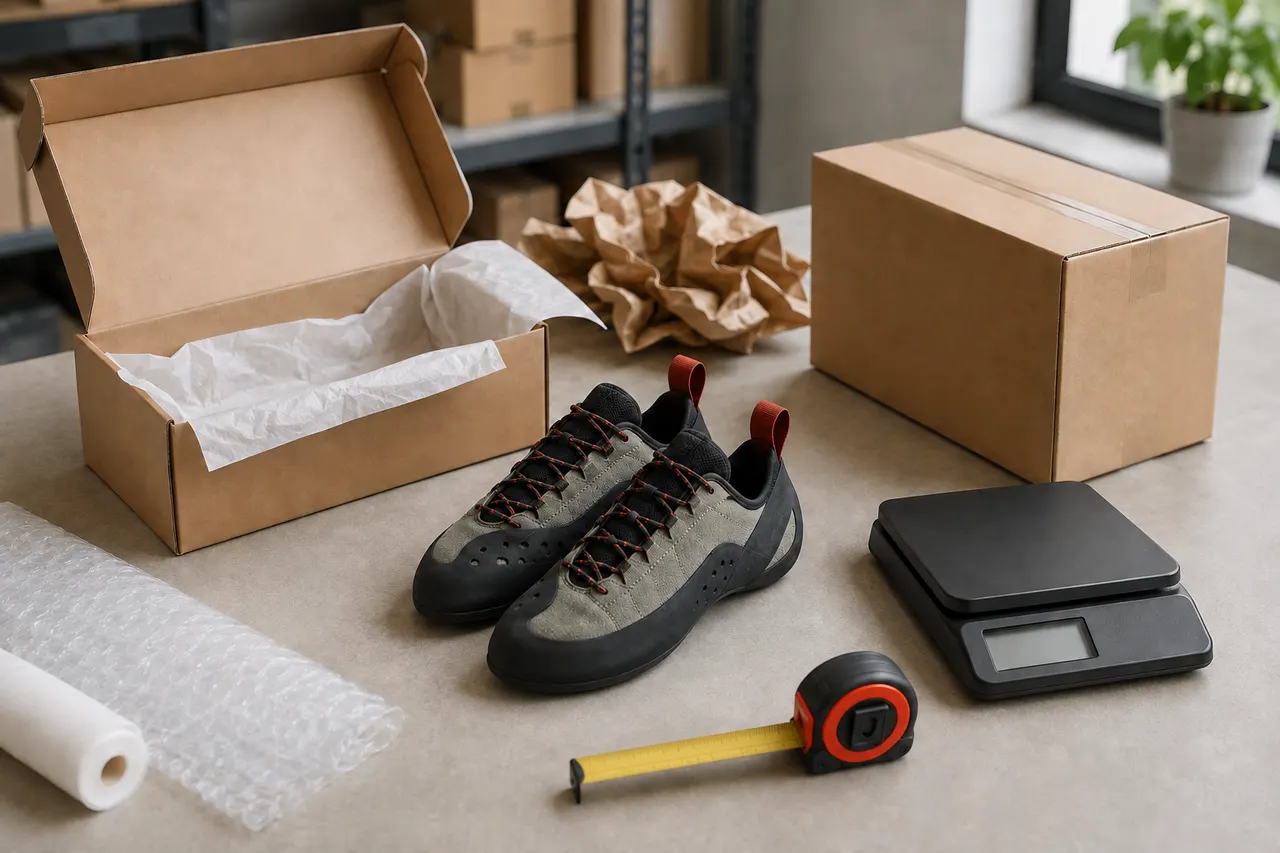
Clarify Three Shipping Needs: Single Shoe, Pair Purchase, and Keeping the Shoe Box
First confirm whether the seller is actually selling a single shoe, a standard pair, or a combination of two or more pairs. Do not infer the quantity from the product image; base it on the order specifications, warehouse intake quantity, and inspection photos.
Before submitting packaging requests, you can categorize your goals into three types:
Single shoe: Common for replacement purposes or special seller items, requiring confirmation of left/right foot, size, and quantity.
Standard pair: Focus on checking whether both shoes are the same model and size, and whether there are shoe bags, spare accessories, or instruction cards.
Keep the full shoe box: Suitable for buyers who need original packaging, gifting, or value packaging integrity, but it usually takes up more volume.
If purchasing multiple pairs, do not simply multiply the weight of one pair by the quantity. The outer box, cushioning materials, and gaps between shoe boxes do not change exactly proportionally; request the warehouse to re-weigh and measure the final package.
What Estimates Can Be Supported by Known Kakobuy Information, and Which Fees Still Need a Quote
As of September 3, 2026, existing Kakobuy platform information indicates that international shipping fees are calculated based on item weight, shipping method, and destination region; total costs may also include item costs, domestic mainland China shipping, and customs clearance fees related to the selected shipping method. The platform offers multiple logistics lines, but existing information does not provide a complete real-time price list applicable to a specific country, line, and weight tier.
Therefore, what can be completed now are weight and volume estimates, packaging option comparisons, and budget formulas; items still needing confirmation via the package page quote include:
Line's first weight, additional weight, or tiered billing standards
Volumetric weight divisor and rules for taking actual vs. volumetric weight
Fuel, remote area, oversize, or handling surcharges
Whether customs clearance fees apply to the selected line and the final amount
Whether coupons are valid, applicable thresholds, and deductible scope
Destination country taxes, carrier restrictions, and estimated transit time
These are facts that may change. Before payment, rely on the Kakobuy package settlement page, line rules, and destination country customs public requirements, not the sample calculations as a quote.
Fields Needed to Record Climbing Shoe Weight, Shoe Box Dimensions, and Packaging Method
After warehouse intake, save verifiable data 📏:
Item quantity, and whether each pair is individually boxed
Intake weight of shoes and original shoe box
Weight of shoes, shoe bags, and accessories after removing the box
Original shoe box length, width, height in centimeters
Final outer carton length, width, height
Packaging material weight
Whether to remove box, fold box, or keep full shoe box
Whether to add shoe trees, bubble wrap, or rigid dividers
Candidate lines' maximum dimensions, prohibited/restricted rules, and volumetric weight divisor
Destination country or region, billing currency, and quote verification date
Recording only the weight listed on the product page is not enough. Seller parameters may not include the shoe box and domestic courier packaging; what truly affects international shipping is the data after warehouse packing is complete.
Calculate Actual Weight and Volumetric Weight Separately and Identify the Likely Chargeable Weight
First calculate using unified units:
Actual weight = shoe and accessory weight + shoe box weight + outer carton and filler weight
Volumetric weight = final package length × width × height ÷ line-specified divisor
If the line rules state billing based on the greater of actual and volumetric weight, temporarily use the following formula:
Estimated chargeable weight = max(actual weight, volumetric weight)
For example, a final package measures 34 × 22 × 14 cm and has an actual weight of 1.15 kg. If the candidate line page explicitly shows a volumetric weight divisor of 6000, the sample volumetric weight is:
34 × 22 × 14 ÷ 6000 = 1.745 kg
At this point, if the line takes the greater of the two, the billing basis may be close to 1.745 kg, but the carrier may also round up per specified units. The divisor, rounding method, and billing tier must be read from the actual line page; do not use the sample 6000.
Use a Cost Table to Compare Removing Box, Folding Box, and Full Shoe Box Options
After obtaining estimated dimensions and weights for the three packaging options, put them in the same table for comparison. Keep unknown fees as "to be quoted" and do not fill in values yourself.
Option | Data to record | Main cost impact | Suitable situations | Main risks |
|---|---|---|---|---|
Remove box | Net weight of shoes and accessories, compressed outer carton dimensions, protective material weight | Usually reduces shoe box weight and occupied volume, but may still fall in the same billing tier | No need for original box, line volumetric weight significantly high | Shoe upper compression, accessories scattered, reduced return/exchange basis |
Fold box | Folded shoe box weight, outer carton dimensions after folding | May reduce volume while retaining some packaging information | Want to keep labels but do not require box shape | Shoe box may be damaged and not restorable |
Full shoe box | Original box and final outer carton dimensions, all packaging weight | More likely to increase volumetric weight and outer carton material | Value packaging integrity or need for gifting | Shipping cost rises, outer carton compression, increased loss per incident |
Calculate each option on the same line:
Estimated total logistics cost = international shipping + confirmed surcharges + confirmed customs fees + estimated destination taxes
Estimated savings from removing box = total logistics cost of full shoe box option − total logistics cost of removing box option
If both options fall in the same billing tier, the actual savings from removing the box may be 0. Without a real-time line quote, also record confirmable savings as 0 rather than claiming a certain amount can be saved.
Check Shoe Shape Protection, Upper Compression, and Accessory Loss Risks
Climbing shoes typically have a curved shape, rubber rands, and a compact upper structure. You cannot judge the material's recovery ability after compression from images alone, so do not treat aggressive compression as a default money-saving method 🧗.
Before removing the box, request via packaging notes:
Pair the shoes together and mark order ownership
Buckles, Velcro, or laces positioned to avoid snagging
Small accessories and instruction cards in separate bags
Toe and heel areas not subjected to continuous hard pressure
Add dividers between multiple pairs to prevent rubber surfaces rubbing
Outer packaging able to withstand normal shipping compression
Warehouse inspection usually can check appearance information such as style, quantity, color, size, and model, but this does not constitute a wear test or performance appraisal. Check quantity, left/right, size label, obvious deformation, and visible defects within the post-intake return/exchange window. Existing platform information mentions a 120-hour return/exchange window for some regular items after intake, with exceptions listed; removing packaging, tags, or accessories may affect return/exchange eligibility, so you must recheck the current rules on the order page before proceeding.
Check Line Rules, Surcharges, and Declaration Information Before Submitting the Package
Complete the following checks before selecting a line ✅:
Enter the real destination country or region and confirm whether the line accepts footwear.
Check whether the line uses actual weight, volumetric weight, or another billing method, and the weight rounding unit.
Verify maximum side length, girth, minimum chargeable weight, and oversize conditions.
Check for fuel, remote area, peak season, or special handling surcharges.
Confirm billing currency, payment conversion result, and actual amount after coupon deduction.
Declare truthfully according to actual item name, quantity, and value, and understand destination taxes and import restrictions.
Save screenshots of line rules, quote page, final weighing and dimensions, while covering name, address, phone, and order number.
Do not evade taxes or inspections through under-declaration, false product names, or unpacking. Splitting packages may solve size or category restrictions on some lines, but may also increase repeated first weights, fixed fees, and loss points, so each package must be calculated based on actual quotes.
Update Budget Based on Final Weighing and Choose Shipping Option
After the warehouse completes packing, replace estimates with final actual weight and outer carton dimensions, and recalculate the three options 📦. If the system only shows one option, record the current quote, then request a packaging change according to platform-allowed operations and obtain a new quote; do not infer new option prices from old dimensions.
Final decision can follow this order:
Exclude lines that do not accept footwear, exceed size limits, or are unavailable for the destination.
Calculate chargeable weight using each line's published volumetric divisor and rounding rules.
Compare international shipping, explicit surcharges, customs fees, and estimated taxes in the same currency.
Calculate actual savings of removing box or folding box relative to full shoe box.
Choose based on shoe shape protection, packaging needs, return/exchange eligibility, and single-loss risk.
The conclusion should not simply be "removing box is cheaper." When a requote shows a clear difference and the shoe box causes an increase in volumetric weight, removing or folding the box is more suitable for buyers who use the shoes themselves, accept packaging loss, and want to control shipping costs; the increased risks are upper compression, accessory loss, and loss of original packaging value. Those who value collection, gifting, resale packaging, or shoe shape protection are better off keeping the full shoe box. If the old and new options fall in the same billing tier, savings are 0, or the platform indicates that removing packaging affects returns/exchanges, removing the box is not recommended.
All prices, lines, transit times, taxes, coupons, and return/exchange conditions should be re-verified on the day of payment.
Agent Platform Shopping FAQ
1. What methods can I use on kakobuy to locate the products I want to buy?
You can enter a single keyword into the search bar, or browse the category pages where items are also grouped by brand. Using longer search phrases usually yields fewer but more accurate results compared to shorter terms. For instance, try searching for "Air Force 1 White," "sneakers," or just "Air Force 1."
2. What should I do if I am not happy with the product I received from my kakobuy order?
Reach out to kakobuy's customer support team as soon as possible. For most non-specialty items sold by Chinese merchants, there is a 5-day no-questions-asked return and exchange policy. If you are unsatisfied, you may ask for a return. If the item has already left the warehouse and been delivered to you, and you find a quality problem, contact kakobuy's customer service so they can assist you in communicating with the merchant to work out a compensation arrangement.
Below are the customer service email addresses for each platform:
kakobuy: [email protected]
oopbuy: [email protected]
usfans: [email protected]
hipobuy: [email protected]
superbuy: [email protected]
3. Why doesn't kakobuy use Google Sheets for product spreadsheets?
Google Sheets works only for spreadsheets with a limited number of products. When the product count grows, loading becomes very slow and the system lags heavily. This is especially noticeable on mobile devices, where the display is poor and searching for products is extremely inconvenient. For the same set of products, kakobuy's website spreadsheet loads faster and provides a better visual experience.
Browse our latest products and find your next favorite item.